
How Many Laser Hair Removal Sessions Do You Really Need?
If you are considering laser hair removal, one of the first questions on your mind is probably how many sessions it will take to see real results. The short answer: most people need six to eight treatments spaced several weeks apart. But the full picture depends on your hair type, skin tone, the body area being treated, and hormonal factors like PCOS. Below, the team at Pink Mink NYC breaks down exactly what to expect so you can plan your journey to smooth, lasting results with confidence.
How Laser Hair Removal Works
Laser hair removal is a cosmetic procedure that uses concentrated beams of light to target and damage hair follicles, reducing future growth. The laser's energy is absorbed by melanin, the pigment inside the hair shaft, which heats the follicle and disrupts its ability to produce new hair.
Because the laser relies on melanin absorption, it works best on hair that is actively growing and richly pigmented. This is why a single session can never eliminate all unwanted hair, and a series of treatments is always required.
The Hair Growth Cycle Explained
The hair growth cycle is the repeating sequence of growth, transition, and rest that every hair follicle passes through independently. It includes three main phases:
Anagen (Growth Phase)
The anagen phase is the active growth stage when the hair is attached to the follicle and contains the most pigment. Only about 20% to 30% of hairs are in the anagen phase at any given time, which is exactly why multiple sessions are necessary.
Catagen (Transition Phase)
During catagen, the hair detaches from the blood supply and growth stops. This phase lasts roughly two to three weeks. Laser treatment during catagen is far less effective because melanin concentration drops.
Telogen (Resting Phase)
The telogen phase is the dormant period when the old hair rests in the follicle before shedding. Because the hair is no longer connected to the follicle's nutrient source, laser energy cannot destroy it during this stage.
Average Number of Sessions by Body Area
Not every treatment area responds at the same rate. Hormonal areas tend to need more sessions because hormones can stimulate new follicle activity even after treatment. The table below provides general ranges based on clinical guidance from the Cleveland Clinic and the American Academy of Dermatology.
| Body Area | Typical Sessions | Session Interval |
|---|---|---|
| Upper Lip / Chin | 6 – 8 | 4 – 6 weeks |
| Underarms | 6 – 8 | 4 – 6 weeks |
| Bikini / Brazilian | 6 – 10 | 4 – 6 weeks |
| Legs | 6 – 8 | 6 – 8 weeks |
| Arms | 6 – 8 | 6 – 8 weeks |
| Back / Chest | 6 – 8 | 6 – 8 weeks |
Each session typically results in roughly 10% to 25% hair reduction, compounding over the full treatment series until most clients achieve up to 80% or greater permanent reduction.
Factors That Affect Your Session Count
Hair Color and Thickness
Darker, coarser hair absorbs laser energy more efficiently than fine or light-colored hair. Clients with thick, dark hair often see faster progress, while those with finer hair may need a session or two beyond the average range.
Skin Tone and Fitzpatrick Type
Your Fitzpatrick skin type influences laser wavelength selection and energy settings. At Pink Mink NYC, every procedure is carefully designed to fit your unique Fitzpatrick Skin Type, ensuring safety and efficacy across all complexions.
Treatment Consistency
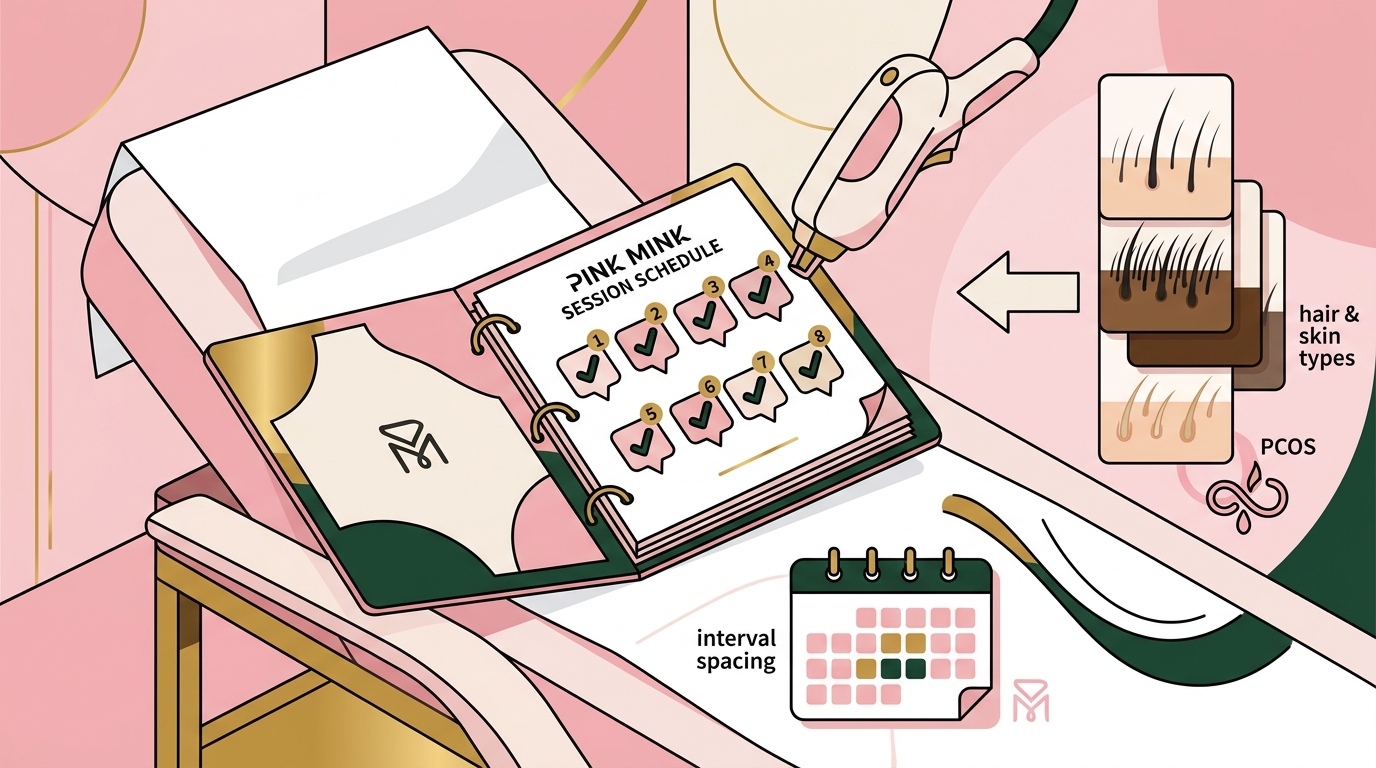
Sticking to the recommended interval between sessions is critical. Sessions are usually spaced four to eight weeks apart so that new follicles cycling into the anagen phase can be targeted at the next visit.
PCOS and Hormonal Hair Growth
Polycystic ovary syndrome (PCOS) is a hormonal condition that causes excess androgen production, often leading to hirsutism, which is the growth of coarse hair in a masculine distribution pattern. Research published in the National Library of Medicine confirms that laser-assisted hair removal significantly improves quality of life for women with PCOS-associated hirsutism.
Because hormonal stimulation can reactivate dormant follicles, PCOS clients typically require additional sessions and periodic maintenance treatments. Dr. Syed and the Pink Mink NYC team specialize in PCOS laser hair removal, combining a groundbreaking laser technique with tailored aftercare to deliver lasting results even for hormonally driven hair growth.
Laser Hair Removal on Melanated Skin
Historically, laser hair removal posed higher risks for clients with darker skin tones because the laser could target melanin in the skin rather than in the hair. Modern Nd:YAG lasers operating at a 1064 nm wavelength solve this problem by bypassing epidermal melanin and focusing energy on the follicle.
Pink Mink NYC's highly experienced staff specializes in melanated skin, selecting the safest wavelength and energy settings for every client. If you have a darker complexion, choosing a provider with this expertise is essential for both safety and effectiveness.
Key Takeaways
- Most people need 6 to 8 laser hair removal sessions for significant, long-lasting reduction.
- Only 20% to 30% of hair is in the treatable anagen phase at any time, making multiple sessions essential.
- Hormonal areas like the face, underarms, and bikini line may require up to 10 or more sessions.
- Each session delivers roughly 10% to 25% hair reduction, compounding over the treatment series.
- PCOS clients often need extra sessions plus periodic maintenance due to ongoing hormonal stimulation.
- Melanated skin requires specialized laser wavelengths; always choose an experienced provider.
- Consistent session spacing of 4 to 8 weeks maximizes results by targeting new anagen-phase hairs.
Frequently Asked Questions
How many laser hair removal sessions does the average person need?
Most people need between six and eight sessions. The Cleveland Clinic recommends six to eight treatments spaced about six to eight weeks apart for optimal results.
Why can't laser hair removal be done in one session?
Only about 20% to 30% of your hair follicles are in the active growth phase at any given time. The laser can only disable follicles during this anagen phase, so repeat sessions are needed to catch every follicle as it cycles through.
Do people with PCOS need more laser sessions?
Yes. PCOS causes elevated androgen levels that stimulate new hair growth. Clients with PCOS often need additional sessions beyond the standard range, plus ongoing maintenance treatments to manage regrowth.
Is laser hair removal safe for dark skin tones?
Absolutely, when performed with the correct laser. Nd:YAG lasers at 1064 nm are considered the safest wavelength for darker skin because melanin absorption at that wavelength is very low. Pink Mink NYC specializes in treating melanated skin safely and effectively.
How far apart should laser hair removal sessions be?
Sessions are typically spaced four to six weeks apart for hormonal areas like the face, underarms, and bikini. Non-hormonal areas such as the legs and back are usually treated every six to eight weeks.
What results can I expect after the first session?
After a single session, many clients notice patchier regrowth and finer hair within two to three weeks. Significant visible reduction usually becomes apparent after two to three treatments.
Do I need maintenance sessions after my initial series?
Some clients benefit from one to two touch-up sessions per year, especially if hormonal factors like PCOS influence hair growth. Maintenance keeps results smooth long-term.
How do I book a consultation at Pink Mink NYC?
You can book your appointment online or visit either location in Queens or Williston Park, NY to start your laser hair removal journey with Dr. Syed's expert team.
Ready to Start Your Laser Hair Removal Journey?
Every client's needs are unique, and the right treatment plan starts with a personalized consultation. Pink Mink NYC's award-winning team has spent over a decade perfecting laser hair removal for every skin type, including PCOS and melanated skin specialists. Book your first laser experience today and take the first step toward smooth, confident skin.