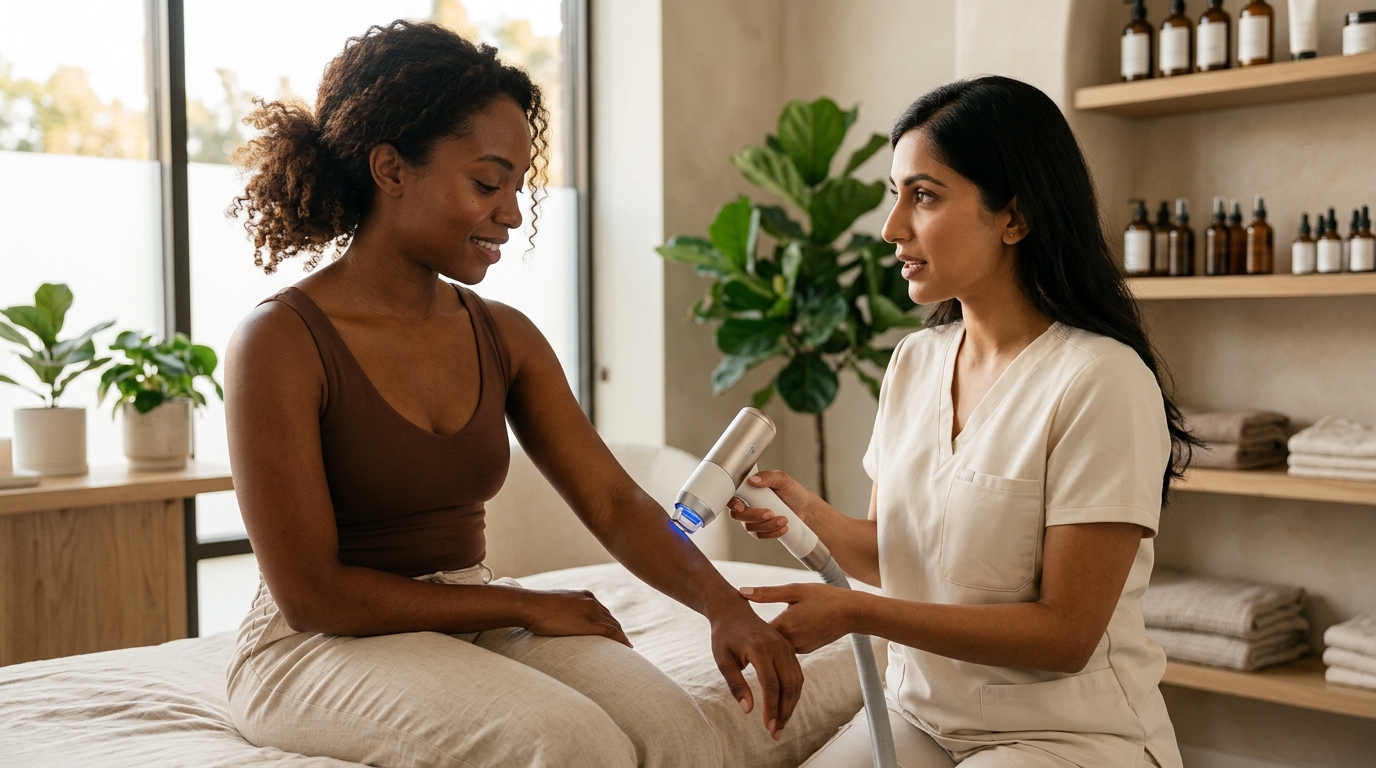
The short answer is yes—and in fact, customization isn't just possible, it's essential. Modern laser hair removal relies on matching the right wavelength, pulse duration, and energy settings to your unique skin tone and hair color. Here's the complete guide to how it works, which technologies matter, and what to expect at every step.
Why Skin Type Matters in Laser Hair Removal
Laser hair removal works by targeting melanin—the pigment inside hair follicles. A laser emits light energy that is absorbed by this melanin, converting it to heat and damaging the follicle so it can no longer produce hair. The challenge is that your skin also contains melanin, and if the laser can't distinguish between skin pigment and hair pigment, problems arise.
For people with darker skin, the epidermis contains more melanin that competes with hair follicles for laser absorption. This means that older, less sophisticated lasers could inadvertently damage the surrounding skin, leading to burns, hyperpigmentation, or scarring. Conversely, people with very fair skin and light hair present the opposite challenge: there isn't enough melanin contrast for the laser to lock onto.
This is precisely why customization matters. A one-size-fits-all approach doesn't just reduce effectiveness—it increases risk.
The Fitzpatrick Scale: Your Starting Point
Before any reputable provider fires a single laser pulse, they'll assess your skin using the Fitzpatrick scale. Developed by dermatologist Thomas B. Fitzpatrick in the 1970s, this system classifies skin into six phototypes based on how it reacts to sun exposure.
- Type I: Very fair skin that always burns, never tans
- Type II: Light skin that burns easily, tans minimally
- Type III: Medium skin that sometimes burns, tans gradually
- Type IV: Olive skin that rarely burns, tans easily
- Type V: Brown skin that very rarely burns, tans darkly
- Type VI: Dark brown to black skin that never burns
This classification guides providers in estimating safe energy doses, selecting the appropriate laser wavelength, and predicting potential complications. It's the foundational tool for customizing every treatment plan.
How Different Lasers Match Different Skin Types
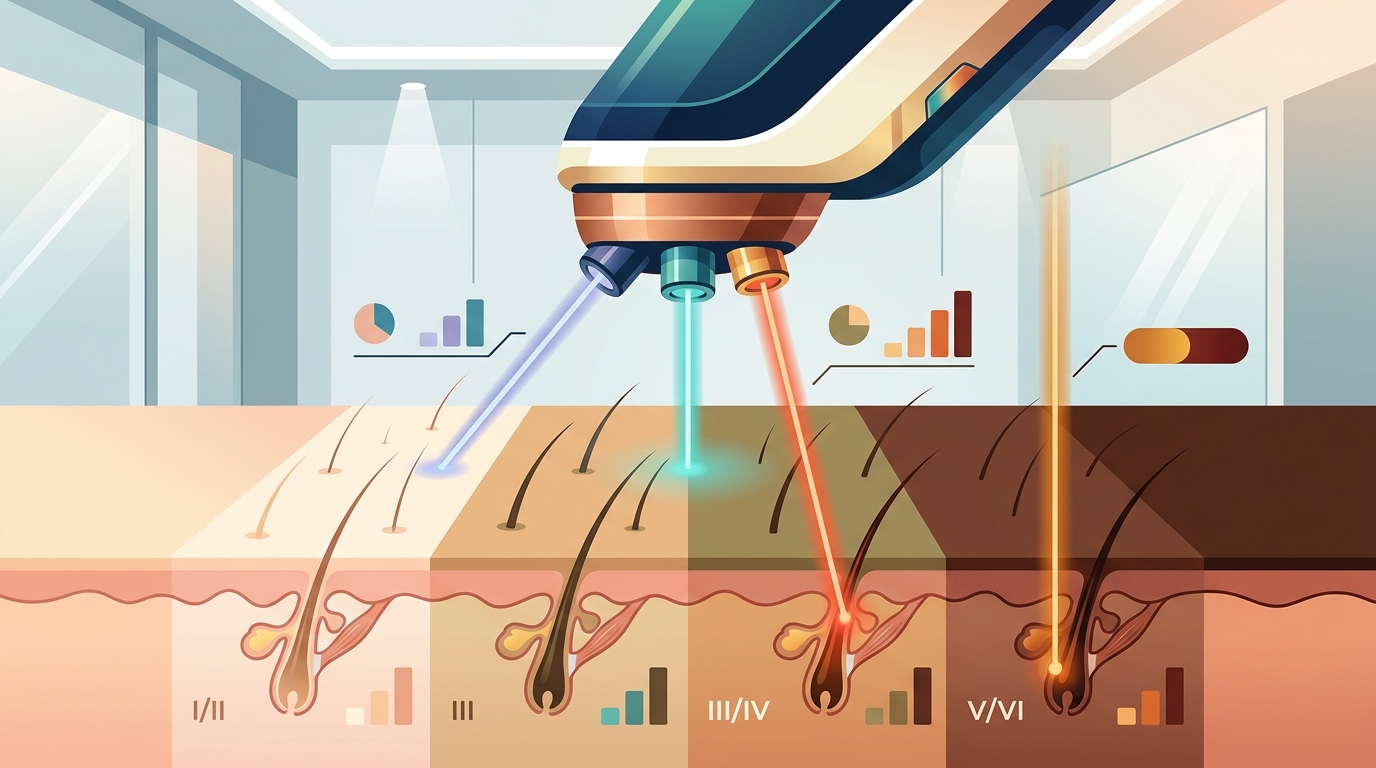
Not every laser is interchangeable. Each wavelength interacts differently with melanin and penetrates to different depths. Here's how the major technologies line up:
Alexandrite Laser (755 nm)
This is one of the most popular and efficient lasers for hair removal. It works exceptionally well on lighter skin tones (Fitzpatrick Types I–III) with dark hair, covering large treatment areas quickly. However, for darker skin types, the 755 nm wavelength carries a higher risk of epidermal damage because it is more readily absorbed by skin melanin.
Diode Laser (810 nm)
The diode laser offers deeper penetration and is versatile enough for light to medium-dark skin tones. It's a strong choice for coarse hair and is considered relatively comfortable. Many clinics use it as a middle-ground option for clients in the Type II–V range.
Nd:YAG Laser (1064 nm)
The Nd:YAG operates at the longest commonly used wavelength for hair removal. Its 1064 nm light penetrates deeper into the dermis while bypassing much of the epidermal melanin. This makes it the gold standard for Fitzpatrick Types IV–VI. While it may require more sessions and can be slightly less comfortable, it dramatically reduces the risk of burns and pigmentation changes on darker skin.
IPL (Intense Pulsed Light)
Technically not a laser but a broad-spectrum light source, IPL is highly customizable because its power levels can be adjusted for different skin tones and hair thickness. It tends to be less painful, though generally considered slightly less effective than true laser systems for permanent reduction.
Dual-Wavelength and Multi-Platform Systems
Many modern clinics now use systems that combine multiple wavelengths on a single platform—for example, pairing an Alexandrite laser with an Nd:YAG. These dual-wavelength machines allow providers to switch between settings for different treatment areas or even within a single session, offering maximum flexibility for clients with varied skin and hair characteristics.
What Customization Actually Looks Like in Practice
True customization goes far beyond simply picking the right laser. A skilled provider adjusts multiple variables for each client:
- Wavelength selection — Chosen based on Fitzpatrick skin type and hair color
- Fluence (energy density) — Measured in J/cm², this is dialed up or down depending on skin sensitivity and hair coarseness. For darker skin, lower initial fluences are used and may be gradually increased across sessions
- Pulse duration — Longer pulses allow heat to dissipate from the epidermis, protecting melanin-rich skin while still damaging the follicle
- Spot size — Larger spot sizes allow deeper light penetration; smaller spots offer precision for delicate areas like the upper lip
- Cooling mechanisms — Contact cooling tips, cryogen sprays, or forced-air cooling protect the skin surface before, during, and after each pulse
- Session spacing — Lighter skin types may follow 4–6 week intervals; darker skin types often benefit from 6–8 week intervals to allow complete healing
- Number of sessions — Lighter skin with dark hair may see significant reduction in 4–6 sessions, while darker skin types may require 8–10 sessions for comparable results
Darker Skin Tones: What Has Changed
Historically, laser hair removal was developed primarily for lighter-skinned patients, and people with deeper skin tones faced real risks of adverse effects. That reality has shifted considerably. The Nd:YAG laser's longer wavelength bypasses surface melanin and targets the hair follicle directly, significantly reducing complications. Diode lasers designed specifically for melanin-rich skin have also expanded the safety profile.
Advanced cooling systems further protect the epidermis during treatment. Skin-type sensors built into newer machines can help technicians select optimal settings and even prevent the laser from firing over areas with discoloration. The combination of these technologies means that safe, effective laser hair removal is now accessible across all six Fitzpatrick types.
That said, provider experience is just as important as the equipment itself. Clients with deeper skin tones should confirm that a clinic has both the appropriate laser technology and a team trained in treating diverse skin.
Fair Skin and Light Hair: The Other Challenge
While darker skin types face melanin-competition issues, fair-skinned clients with blonde, red, or gray hair encounter the opposite problem—insufficient pigment for the laser to target. Traditional lasers rely on melanin absorption, so very light hair is inherently difficult to treat.
Emerging solutions include novel dye systems that artificially pigment the hair shaft before treatment, and longer-pulse technologies designed to improve efficacy on lighter hair. While results for blonde or gray hair remain less predictable than for dark hair, the technology continues to advance.
Choosing the Right Provider in NYC
When seeking customized laser hair removal in New York City, consider the following checklist:
- Multiple laser platforms: A clinic with access to more than one wavelength can treat a wider range of skin and hair types safely
- Fitzpatrick assessment at consultation: Any provider who skips skin typing is cutting corners
- Experience with diverse clientele: NYC's population spans the full Fitzpatrick spectrum—choose a team that treats all skin tones routinely
- Transparent communication: A good provider explains which laser they'll use, why, and what realistic outcomes to expect for your specific combination of skin and hair
- Post-treatment protocols: Sun protection guidance, soothing products, and clear aftercare instructions are non-negotiable
At Pink Mink NYC, consultations begin with a thorough skin assessment to determine your Fitzpatrick type and design a personalized treatment plan that accounts for your skin tone, hair color, treatment area, and sensitivity.
Key Takeaways
- Laser hair removal is absolutely customizable—and must be customized for safety and effectiveness
- The Fitzpatrick scale is the standard tool for matching patients to the right laser technology
- Alexandrite lasers excel on fair to medium skin; Nd:YAG is the gold standard for darker tones; diode lasers bridge the middle ground
- Customization involves wavelength, fluence, pulse duration, spot size, cooling, session spacing, and total session count
- Modern dual-wavelength systems and advanced cooling have made laser hair removal safe for all six Fitzpatrick types
- Provider expertise and appropriate equipment are equally important—especially for melanin-rich skin
Frequently Asked Questions
Is laser hair removal safe for dark skin?
Yes. With the right laser—typically an Nd:YAG at 1064 nm—and a trained provider, laser hair removal is safe and effective for Fitzpatrick skin types IV through VI. The key is selecting technology that bypasses epidermal melanin to target the hair follicle directly.
Which laser is best for fair skin?
Alexandrite lasers (755 nm) are generally considered the most efficient option for Fitzpatrick Types I–III with dark hair. Diode lasers are also highly effective for this range and offer a comfortable treatment experience.
Can people with blonde or red hair get laser hair removal?
Blonde and red hair contain less melanin, making traditional laser treatment less effective. However, emerging technologies including pre-treatment dye systems and longer-pulse lasers are improving outcomes for lighter hair colors.
How many sessions will I need?
Most people require 6–8 sessions spaced 4–8 weeks apart. Lighter skin with dark hair may see results faster (4–6 sessions), while darker skin types or areas with finer hair may need 8–10 sessions for optimal reduction.
What should I look for in a laser hair removal provider?
Look for a clinic that performs a Fitzpatrick skin type assessment, has multiple laser wavelengths available, employs trained and experienced technicians, and provides clear aftercare guidance. In a diverse city like New York, experience with all skin tones is essential.
Does customization affect the cost of treatment?
Customization can influence pricing because different lasers and session counts may be required. However, a properly customized plan delivers better results and avoids costly complications from using the wrong technology.